How much does a trade show booth design cost, and what factors determine the price?
This is one of the most frequently asked questions among companies planning to exhibit at trade shows. In the event and exhibition industry, a well-designed booth is a critical element of brand visibility, customer engagement, and effective presentation of products or services. At the same time, it is impossible to provide one universal price — every booth is different, and the project depends on numerous variables.
In this guide, we explain:
- what determines the cost of a trade show booth design,
- why one booth design may cost significantly more than another,
- what a professional project includes,
- why detailed technical documentation and cut-list preparation give the client a major advantage,
- and how cooperation with a professional design studio such as Fusion Craft Studio works.
Trade show booth design, trade show booth cost, booth design services, 3D booth visualizations, technical documentation, custom trade show booths, booth design over 1000 m², booth design Spain, CAD projects, and many others.
Why Do Trade Show Booth Design Costs Vary So Much?
The price depends mainly on three key areas:
- the size of the booth,
- the complexity of the structure,
- the scope of documentation provided to the client.
These three elements determine whether a project is simple — or highly demanding, both technically and in terms of production time.
1. Booth Size — from 9 m² to Over 1,000 m²
Size is one of the primary pricing factors. A booth may have:
- 9–12 m² (standard corner or island booths for small companies),
- 20–50 m² (the most popular range),
- 100–300 m² (extensive builds for premium brands),
- over 500 m²,
- and even more than 1,000 m² — typical for international companies with advanced product displays.
Yes — Fusion Craft Studio also designs very large booths of 1,000–1,500 m² and above, including full technical documentation, 3D visualizations, and complete CAD breakdowns.
Large booths require a different design methodology, including:
- visitor flow analysis,
- functional zoning,
- multi-level or suspended structures,
- electrical and lighting design,
- combining multiple material technologies (MDF, board, steel, glass, LED, structural mesh),
- compliance with trade show regulations in various countries.
Thus, the scope — and therefore the cost — increases proportionally with size and complexity.
2. Structural Complexity
Two booths of the same size may differ in price several-fold. Although we do not provide price ranges in this article, understanding the reasons behind these differences is essential.
Elements that significantly affect the final price include:
- custom shapes and geometric forms,
- suspended structures,
- two-storey constructions,
- large backrooms and storage areas,
- custom furniture designed from scratch,
- illuminated elements and LED installations,
- interactive and multimedia components,
- large-format screens or touch displays,
- natural or advanced composite material applications.
Each additional element requires:
- engineering calculations,
- detailed technical design,
- assembly drawings,
- structural testing,
- precise detailing.
This is why some projects are fast and straightforward, while others require many dozens of work hours.
3. Scope of Documentation — What Are You Actually Paying For?
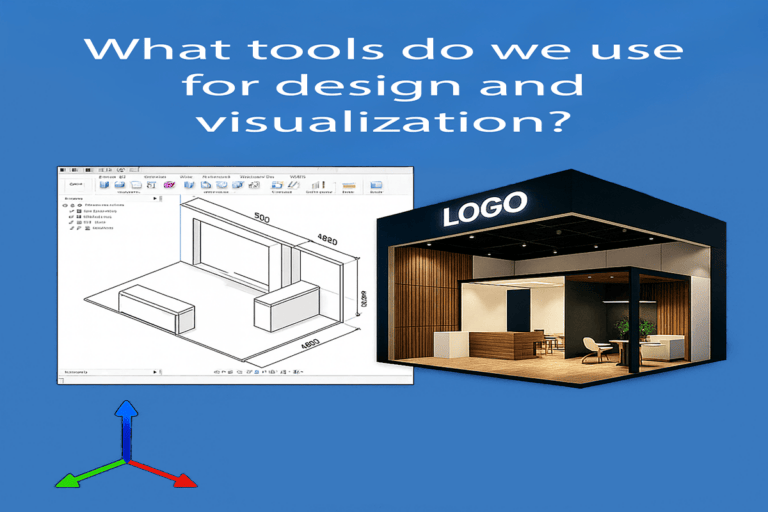
A trade show booth design is not just a nice 3D render. A professional project includes a full set of technical materials.
A standard package typically includes:
- concept and functional layout,
- 3D visualizations (renderings),
- a complete CAD model of the booth,
- technical drawings — plans, sections, and dimensions,
- bill of materials (BOM),
- electrical and lighting design,
- structural elements,
- fully prepared cut lists for woodworking shops,
- assembly instructions.
The more comprehensive the documentation, the higher the value of the project — and the greater the assurance that the booth will be executed correctly.
Why Are Detailed Cut Lists Such an Advantage for the Client?
At Fusion Craft Studio, we provide not only visualizations and technical drawings, but also a full material breakdown and cut lists. This gives the client several important benefits:
✔ Freedom to choose any fabrication company
You are not tied to one contractor.
✔ Quality and material control
You ensure that the booth is not “optimized” at the expense of durability or visual quality.
✔ Savings in production
A precise material list prevents waste and errors.
✔ Faster assembly
Less improvisation on-site = higher safety and stability.
✔ Greater budget predictability
Technical documentation minimizes unexpected costs.
Additional Factors That Influence Trade Show Booth Costs
For SEO and full industry clarity, here are additional variables:
- type of trade show (technology, beauty, industrial, automotive),
- location — major trade show hubs across Europe from Scandinavia to Portugal and the United Kingdom,
- materials used (MDF, 18 mm plywood, 16 mm chipboard, aluminum, glass),
- LED lighting and electrical systems,
- branding, UV graphics, large-format printing,
- multimedia, screens, touch panels,
- suspended and multi-level structures,
- number of custom details and furniture items,
- premium renderings and 3D animations,
- express delivery or last-minute deadlines,
- number of revisions and modifications.
This ensures the article covers keywords related to both costs and the design process.
Why Invest in a Professional Trade Show Booth Design?
Even a simple booth executed by specialists delivers measurable benefits:
1. Stronger brand visibility
A well-designed booth aligned with sales psychology attracts more visitors.
2. Higher perceived professionalism
Consistent visual identity and refined aesthetics build trust.
3. Fewer production errors
The better the documentation, the fewer surprises during construction.
4. Lower production and assembly costs
CAD documentation + full cut lists optimize manufacturing.
5. Booth reusability
You only need new graphics and minor adjustments for the next event.
What Does Cooperation with Fusion Craft Studio Look Like?
We highlight our strengths in a subtle, value-driven way:
✔ End-to-end trade show booth design
From concept to fabrication documentation and cut lists.
✔ We design small, medium, and very large booths — even over 1,000 m²
Complex constructions are fully within our capability.
✔ Over 20 years of experience in the trade show industry
Real, practical know-how — not just aesthetics.
✔ Professional CAD-based workflow (Fusion 360, Inventor)
Projects are precise and fully ready for fabrication.
✔ Transparent communication and consultations at every stage
The client maintains full control of the outcome.
Summary
The cost of a trade show booth design depends on many factors: size, complexity, documentation scope, and customer expectations. There is no single universal price — every booth requires an individual quotation.
Key points:
- booths can be designed from 9 m² up to more than 1,000 m²,
- the larger and more complex the project, the more documentation is required,
- a professional booth design is not just a visualization but a full technical package,
- cut lists save time, money, and give full control over execution,
- working with an experienced studio ensures reliability, safety, and high-quality results.